
Search Michigan Probate Court Records
Michigan probate court records are held at each of the 83 county probate courts across the state. These records cover estate administration, wills, guardianships, conservatorships, and trust matters. You can search probate court records online through the statewide MiCOURT portal or by going to the local court in the county where the case was filed. Each county keeps its own set of case files. Some courts let you look up basic case info for free on the web. Others need you to call or visit in person. This guide walks through how to find and get copies of Michigan probate court records no matter which county you need.
Michigan Probate Court Records Overview
Where to Find Michigan Probate Court Records
The probate court in each Michigan county is the main place to find these records. Michigan has 83 counties and each one runs its own probate court. The court handles estates of people who died, guardianship cases for minors and adults, conservatorships, trusts, and mental health proceedings. The State Court Administrative Office (SCAO) in Lansing oversees all courts statewide and sets the rules for how probate courts operate. But the records themselves stay at the county level.
You can start a search for Michigan probate court records through MiCOURT, which is the state's free online case lookup tool at micourt.courts.michigan.gov. It covers civil, criminal, domestic, and probate cases. You pick the county, choose "Probate" as the court type, and then type in a name or case number. The tool shows basic case info like the filing date, case status, party names, and docket entries. Not all courts take part in MiCOURT. Some counties have their own search portals. Wayne County runs a full case access system at wcpc.us. Oakland County uses a tool called Court Explorer at courtexplorer.oakgov.com. Kent County has its own search page at accesskent.com.
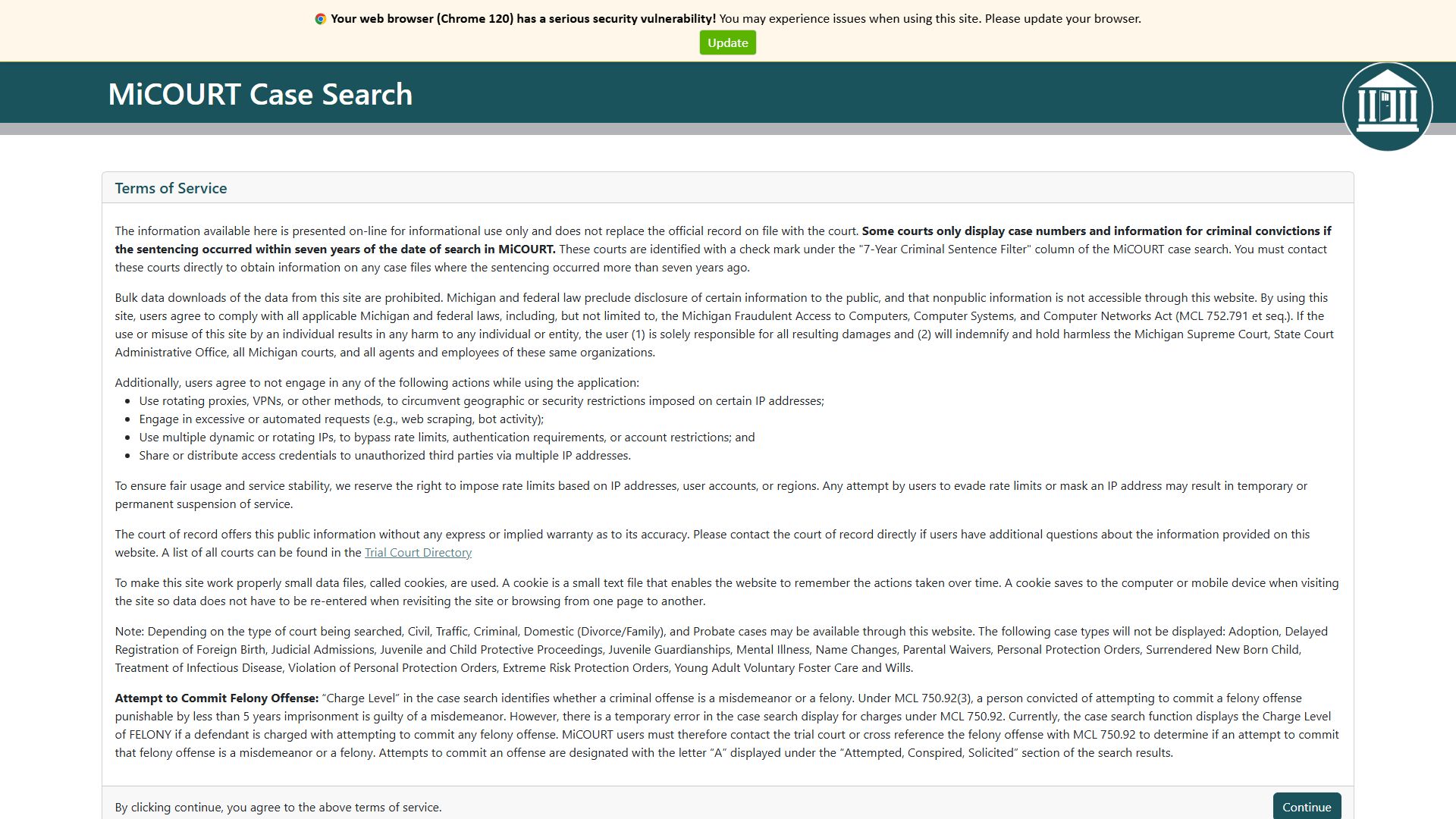
If the county you need is not on MiCOURT, call the probate court directly. Staff can tell you what records they have and how to get copies. Most courts are open Monday through Friday from 8:00 AM to 4:30 PM or 5:00 PM.
Note: Not all Michigan probate courts participate in MiCOURT. Check with the county court if your search turns up no results online.
How to Search Probate Court Records Online
Michigan offers more than one way to search probate court records on the web. The best tool depends on which county holds the case. MiCOURT is the broadest option since it pulls from many courts at once. To use it, go to the site and pick the county from the dropdown. Select "Probate" under court type. Then type in a last name, first name, or case number. Results show the case number, filing date, case type, status, and a list of docket entries. You can also see scheduled hearings. The search is free. But document images are not always there. Some case types like adoptions, juvenile matters, and mental health cases are restricted under MCR 8.119, which sets the rules for public access to court records.
Bigger counties run their own search tools with more detail. Wayne County Probate Court has a full case access portal on its site. You can search by name, case number, date range, or case type. It shows the case summary, all parties, events, the docket, and even financial info. Oakland County takes a different approach. You need a case number to search on Court Explorer. To get the case number, search by name on MiCOURT first. Then go back to Court Explorer to view documents. Macomb County runs CourtView at circuitcourt.macombgov.org, and Washtenaw County has a public access portal at tcweb.ewashtenaw.org.
Electronic filing is another part of the system. The MiFILE portal lets attorneys and some parties file court papers online. This speeds up the process and keeps digital copies in the system. Not every county is on MiFILE yet, but more join each year.
Types of Michigan Probate Court Records
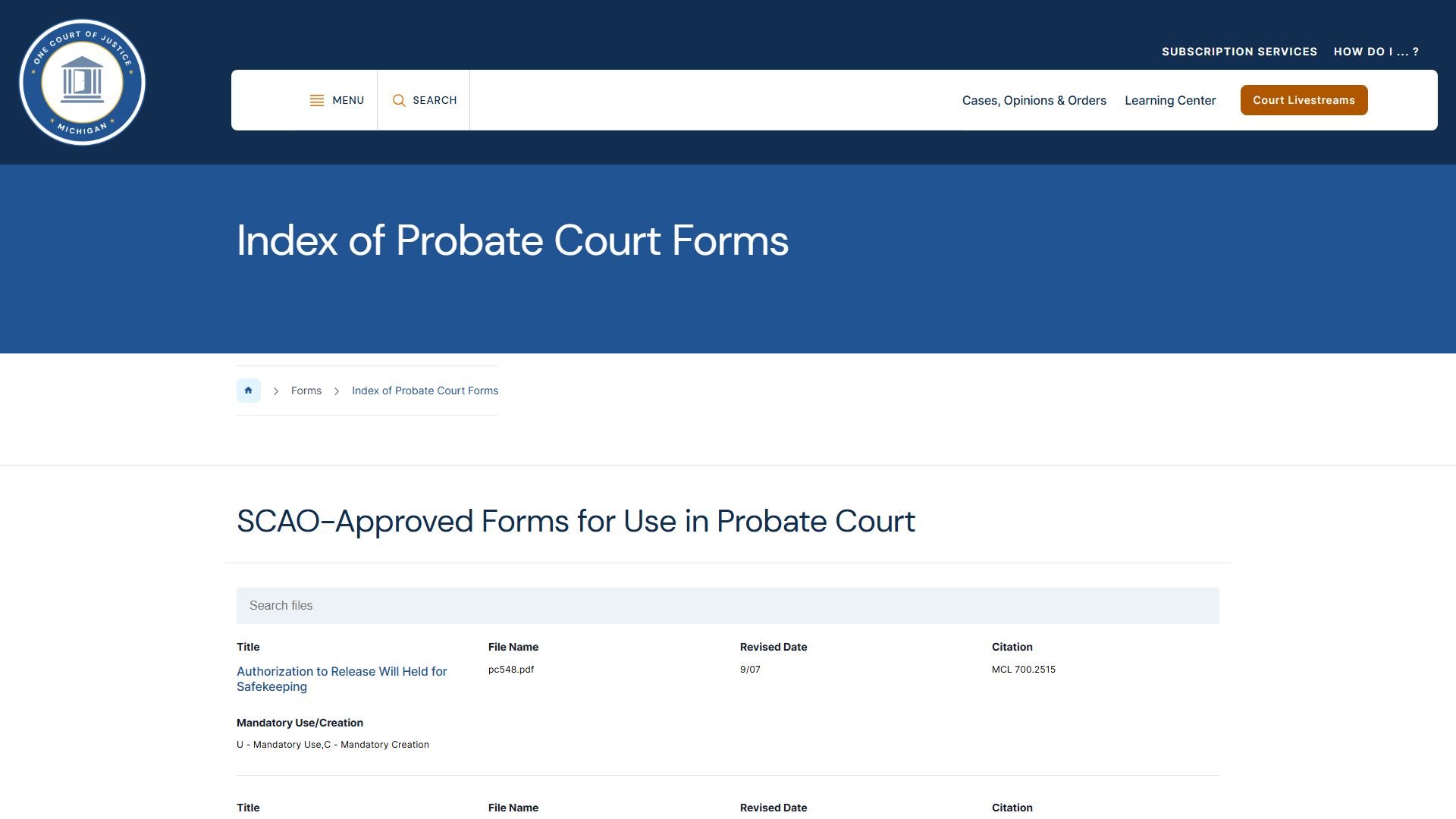
Probate court records in Michigan cover a wide range of case types. The most common are estate cases. When a person dies, someone files a petition to open the estate. The court appoints a personal representative to manage the process. The file will hold the original will (if there is one), the petition for probate, letters of authority, inventories of assets, accountings, and the final order closing the estate. Michigan uses SCAO-approved forms for all filings under MCL 600.855. Form PC 558 is for informal probate. Form PC 559 is for formal probate. These are standard across all 83 counties.
Guardianship and conservatorship records make up another big chunk of probate court files. A guardianship case starts when someone files a petition saying a minor or adult cannot care for themselves. The file includes the petition, physician reports, bond information, annual reports on the ward's condition, and court orders. Conservatorship files are similar but focus on managing the person's money and property. Form PC 625 starts an adult guardianship. Form PC 630 starts a conservatorship. All of these forms are free to download from the SCAO probate forms page.
Trust cases, mental health commitments, and small estate proceedings round out the types you will find. Small estates worth $15,000 or less can skip formal probate under MCL 700.3982. The heir files an affidavit instead. Mental health records have tight access rules and are not public in most cases.
Michigan Probate Court Records and the Law
All probate proceedings in Michigan fall under the Estates and Protected Individuals Code, known as EPIC. The full text is at MCL 700.1101 et seq. EPIC took effect on April 1, 2000 and replaced the old Revised Probate Code. It governs estates, trusts, guardianships, conservatorships, and protective proceedings. MCL 700.1302 gives probate courts exclusive jurisdiction over these matters. MCL 700.1303 adds concurrent jurisdiction for things like property disputes and contract actions by estates.
If someone dies without a will, MCL 700.2102 sets the order of inheritance. A surviving spouse gets the whole estate if there are no descendants. With descendants, the spouse gets the first $150,000 plus half of what remains. Kids split the rest. If there is no spouse, children inherit everything. Parents come next, then siblings. These rules show up in probate court records when an estate goes through intestate succession.
Fees for probate court records follow a set schedule. MCL 600.871 lays out the inventory fee based on estate value. Small estates under $1,000 pay $5 plus 1% of the amount over $500. Larger estates pay on a sliding scale. An estate worth $100,000 to $500,000 pays $362.50 plus 1/8 of 1% of the amount over $100,000. Filing fees for opening a case range from about $150 to $210 depending on the county and type of petition. Certified copies of probate court records cost $10 to $12 for the first page and $1 for each extra page at most courts. Plain copies run $1 to $2 per page.
How to Get Copies of Probate Court Records
Getting copies of Michigan probate court records takes a few steps. First, find the county where the case was filed. Most cases are in the county where the person lived at the time of death or where the ward resides. Once you know the county, you have three main ways to get records: in person, by mail, or online.
For an in-person visit, go to the probate court during business hours. Bring the case number if you have it. The staff can also look up cases by name. You can view files at the courthouse at no charge in many counties. When you want copies, you pay at the counter. Cash, checks, and credit cards are accepted at most locations. For a mail request, write to the court clerk with the case number, party names, and the specific documents you need. Include a check or money order for the estimated fees. Add a self-addressed stamped envelope. Response time is usually 5 to 10 business days.
Online access works well for basic info. Counties like Wayne, Oakland, Kent, and Washtenaw have portals that show case details for free. But if you need certified copies or full documents, you will still have to go through the court. Some courts take email requests too. Wayne County accepts them at filedept@wcpc.us. Macomb County takes requests at sheila.lipari@macombgov.org. The court will tell you the cost and how to pay.
Note: Bring the case number when you visit a probate court. It speeds up the search and helps staff find your file right away.
Legal Help for Michigan Probate Court Records
Michigan Legal Help is a free online resource with self-help tools and form instructions for probate matters. The site walks you through the steps for opening an estate, filing for guardianship, and other common probate tasks. All official court forms are available at the SCAO website.
The State Bar of Michigan runs a lawyer referral service that can match you with a probate attorney. Legal Services of Eastern Michigan, Legal Aid of West Michigan, and the Michigan Advocacy Program all offer free legal help to people who qualify based on income. If you need to research historical probate records for genealogy, the Archives of Michigan in Lansing holds estate packets from Wayne County going back to 1797 and many other counties from the 1800s. FamilySearch also has digitized Michigan probate records covering 1797 to 1973 for most counties.
Are Probate Court Records Public in Michigan
Most probate court records in Michigan are open to the public. You do not need to be a party to the case. You do not need to give a reason for your request. Court rules under MCR 8.119 set the standard for public access to records. Walk into any probate court and you can ask to see a file.
Some records have limits. Mental health cases are restricted by law. Juvenile guardianship files may be sealed. Adoption records are confidential. Personal protection orders and name changes from before certain dates might not be online either. These rules protect the privacy of vulnerable people. But the vast majority of estate, trust, and adult guardianship records are fully open. If you find a case on MiCOURT or a county portal, you can usually view the docket and get copies from the court.
Browse Michigan Probate Court Records by County
Each of Michigan's 83 counties runs its own probate court. Pick a county below to find local contact info, fees, and search tools for probate court records in that area.
Probate Court Records in Major Michigan Cities
Residents of major cities file probate cases at their county's probate court. Pick a city below to learn which court handles probate court records for that area.